
Role
UX/UI Designer
Duration:
October 2023, - April 2024
Tools
Figma, Figjam, Balsamic, & Illustrator
INTRODUCTION
Mediary is an AI-powered app that helps patients capture, understand, and apply information from medical consultations. I followed a full end-to-end UX process to explore how design and AI could meaningfully reduce patient confusion, cognitive overload, and barriers to care.
Framing the Problem
Imagine sitting in a cold, intimidating exam room, already anxious. The doctor enters, reviews your chart, and delivers bad news. Panic surges, a loud buzzing fills your ears, and the rest of the conversation becomes a blur. You know the information matters, but you can’t take any of it in.
Patients will immediately forget
40% to 80%
of the information they receive during a medical consultation.
ONLY 12% of adults demonstrate adequate health literacy skills
Patients forget or misinterpret up to 80% of information from medical visits, often due to stress, rushed appointments, complex terminology, and language or cognitive barriers. (The Cardiology Advisor)
QUESTION
How can we help the patient effectively process, understand, recall, and apply the information received during a medical consultation?
Research
-
Market Scan: Reviewed healthcare apps and support tools to identify gaps in understanding, retention, and follow-through.
-
User Interviews (18 participants, diverse backgrounds): Explored experiences of patients, caregivers, and those with language or cognitive challenges.
-
Key Insight: Most users struggle to retain or accurately apply medical information.
-
Additional Patterns: doctor-speak = confusion, appointments overwhelm, caretakers feel excluded, language barriers, and emotional overload at diagnosis.
What is your first-hand experience with the topic?
-
What is your experience with medical diagnoses?
-
Have you ever experienced a situation where you or a loved one received a significant medical diagnosis?
o Walk me through that experience
o How did it affect you or your loved one?
-
If so, what was your journey to diagnosis?
o What support did you have?
o What type of medical support did you have?
-
How do you classify your diagnosis? Some examples are:
o Short-term or Long-term?
o Ongoing or Resolved?
o [it’s complicated]
-
What is the most pressing question you have about the diagnosis?
How does this affect you? How have you been impacted?
-
What was your life like pre-diagnosis?
-
What were your initial thoughts when you were made aware of this diagnosis?
-
How did you cope initially with the changes?
o Mentally?
o Emotionally?
o Physically?
-
What emotions come to the surface as you reflect on this topic?
SAMPLE QUESTIONS FROM THE DISCUSSION GUIDE
Analysis
ARCHETYPES:
-
Navigator — proactive, organized, manages multiple care needs
-
Responder — overwhelmed, reactive, low medical literacy

NAVIGATOR
"TI take action now and make things happen FOR me. I refuse to wait for them to happen TO me."
END GOAL: To understand their care within the limits of their capabilities.

RESPONDER
"They are giving me the information, but I am having a really difficult time processing it."
END GOAL: To understand their care within the limits of their capabilities.
JOURNEY MAPPING:
Identified pain points and opportunities across symptoms → diagnosis → treatment → recovery.

EXECUTIVE INSIGHTS:
Users feel lost, stressed, and unsupported; simplifying and clarifying guidance is a major opportunity.
EXECUTIVE SUMMARY
SITUATION
Despite having multiple tools available to help them, individuals dealing with the stress of a new medical diagnosis often feel completely overwhelmed and lost in the medical process.
TENSION
Navigating the complexities of the medical system can be stressful and confusing under the best of circumstances, but facing additional strain from an unforeseen medical diagnosis can make patients’ situations and care extremely difficult to manage by themselves.
OPPORTUNITY
Those facing unforeseen medical diagnoses can benefit greatly from clear medical guidance and targeted support, creating the necessary environment for reaching a full medical recovery or resolution.
Concept Development
Explored solutions that would:
-
Capture medical consultation content
-
Transform information into accessible formats
-
Reduce language barriers
-
Improve recall and follow-through
BASIC CONCEPT SKETCHES

Defined four core features:
Recording Audio
Accessible formats
Sharing
Translation
PERSONAS:
To further direct my design, I created three potential personas:


CONCEPT TESTING (Wireframes):
Validated desirability; recording/transcription and translation resonated most. Identified missing feature: AI-suggested questions.

PAPER PROTOTYPING:
Quickly explored layout variations, refined user flows and Information Architecture.


USABILITY TESTING (Lo-Fi Figma Prototypes):
Key improvements based on useability testing feedback:
-
Removed confusing live note-taking
-
Replaced ambiguous onboarding wording
-
Standardized navigation
-
Refined the Questions & Concerns tool

Final Solution | Hi-Fi Prototype
MOOD BOARD and SAMPLE UI ELEMENTS

MOBILE APP DESIGN:
Designed a system where users can: record consultations and receive transcripts with timestamps, speaker labels, highlights, and definition pop-ups.
-
View smart summaries, pinned terminology, and personalized action items.
-
Translate audio or text into their preferred language.
-
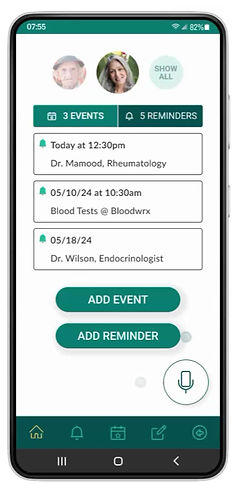
Use an AI assistant (Ask Mediary) for questions, reminders, and preparation for future appointments.
-
Manage multiple profiles for dependents or shared care needs.
AUDIO RECORDING & TRANSCRIPTION

TRANSCRIPT, LANGUAGE TRANSLATION, & AUDIO PLAYBACK

A transcript is created from the recorded audio and can optionally be converted into your preferred language.
TRANSCRIPTION SUMMARY, ACTION ITEMS, & LANGUAGE TRANSLATION

MEDICAL TERM SEARCH

Highlighting terms within the transcript will offer an AI POWERED MED TERM DEFINITION POPUP for clarification. Option to pin the definition for future reference.
ASK MEDIARY

Ask Mediary is an interactive AI assistant that can help you:
-
Ask a medical question
-
Set a new reminder OR change an existing one
-
Add a question or concern to the Q & C list for an upcoming appointment
Optional: When privacy is needed, or writing out your request is preferred, you can click on the speech bubble and open a text interface.
Ask Mediary Animated Demo
Evalutation & Future Direction
Positive feedback indicates strong market potential, but privacy and AI accuracy must be addressed through consent, encryption, and disclaimers.
Planned next steps include:
-
Expanded AI features (e.g., suggested real-time questions)
-
Broader accessibility research (ASD, TBI, dementia)
-
Continued refinement toward a production-ready product
TLDR: Mediary is a UX case study in which I used a full end-to-end design process to explore how AI could help patients better capture, understand, and apply information from medical consultations. Through research, archetype development, journey mapping, and iterative testing, I identified consistent pain points around overwhelm, low health literacy, and information loss. The resulting hi-fi prototype offers recording, transcription, translation, and AI-assisted guidance to reduce cognitive load and support clearer, more confident patient follow-through.